I have been writing .NET for the better part of two decades now, across dozens of projects. Different domains, different teams, different decades — and yet there is one thing I can almost always count on finding when I open a solution: a project called Core. Or Kernel. Or Shared, Common, Utils — pick your favourite. It is the most reliable constant in our industry, more dependable than a NullReferenceException with a callstack that points everywhere except at the actual bug.
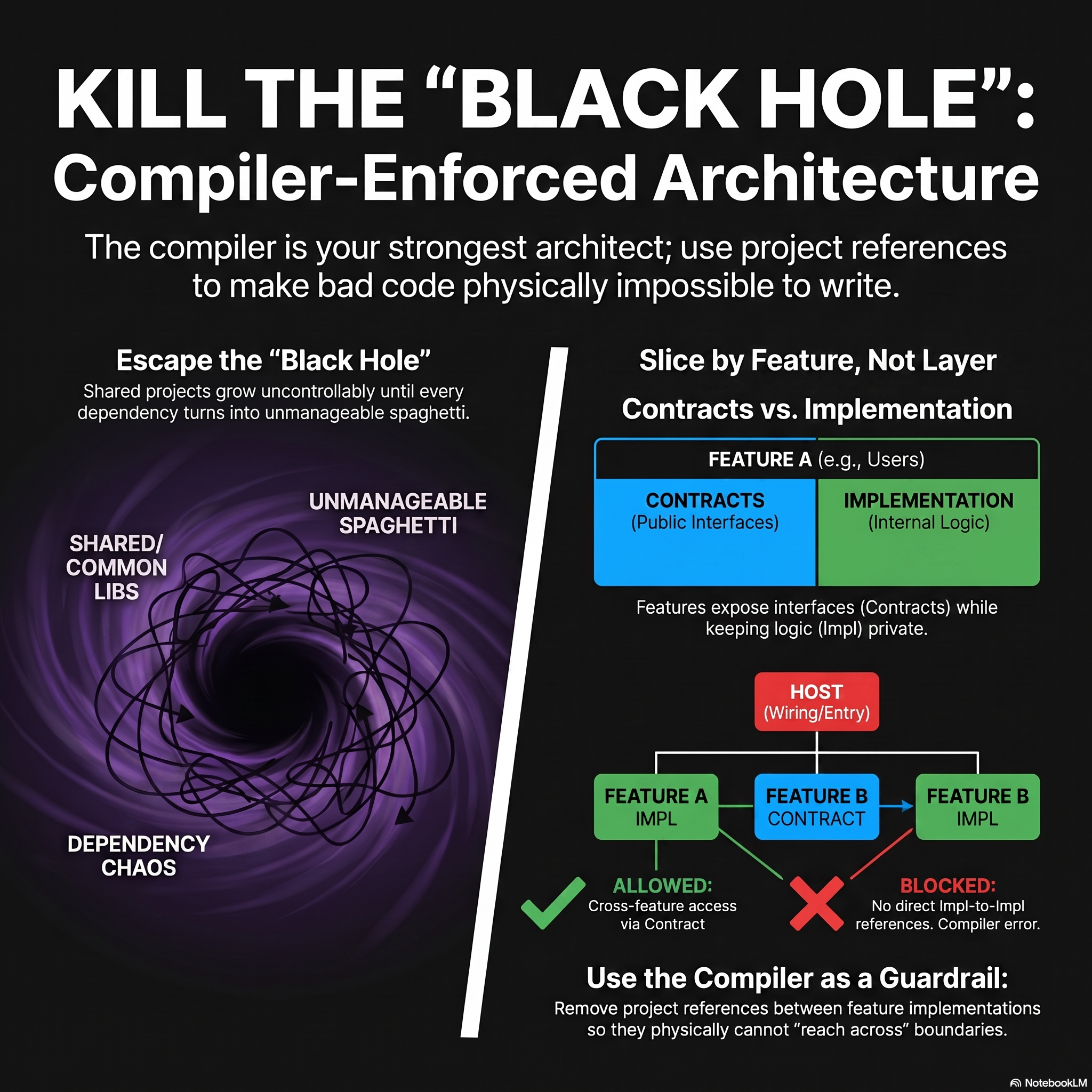
And honestly, it always starts from a good place. You write a helper, then another feature needs it too, so you pull it into a shared library. Reasonable! That is literally what libraries are for. Nobody sits down on day one and decides to build a monster. The monster grows quietly, one innocent static class at a time, while everyone is busy shipping features.
Problem
Give that shared library a year and it grows a kind of gravity: every new class drifts into it, because dropping something into Common is always the path of least resistance. The result is a single project that contains a little bit of everything and a clear picture of nothing. You know the helper you need is in there somewhere. Good luck finding it.
Two pains show up, and they reinforce each other:
- Cognitive overload. Everything depends on
Common, andCommonslowly grows to depend on everything, so the dependency graph turns into a hairball. You can no longer reason about a change in isolation, because there is no isolation left. - Ownership. It is shared, so everyone owns it — which is a polite way of saying nobody does. A change in
Commoncan ripple into any corner of the system, and the person making it rarely knows every corner. So nobody wants to touch it, and it ossifies.
A big part of how we get here is the habit of splitting code by technical layer: Data, Models, Services, Helpers. Each feature’s bits get smeared across these horizontal buckets, and the buckets become the catch-all libraries by construction. A single “create user” feature ends up scattered across four projects, none of which is about users.
It is never just one shared project
Here is the part that I have watched happen more than once. It rarely stays a single Common. The first circular reference forces a split — Common wants to call into DataAccess, but DataAccess already references Common, and the compiler refuses to play along. So someone spins off Common.Core. Then Common.Utils. Then Shared, Shared.Models, SharedKernel, Company.Framework… a whole constellation of catch-alls orbiting your solution. Three things follow, and they compound:
- Dependency hell and cycles. The reference graph turns to spaghetti, and sooner or later you get something like
Utils → Core → Utils(or, if these are NuGet packages, the version-conflict flavour of the same headache). The usual “fix” is to merge two of them, which just makes the ball bigger. - Convention vacuum. There is no written rule for where a new class goes. Does a fresh DTO belong in
Common.Models,Shared.Contracts, orCore.Dto? People pick “wherever it compiles” or copy whatever the neighbour did — cargo-culting that quietly speeds up the entropy. - Lost rationale. Why is
StringExtensionsinCorebutDateExtensionsinUtils? Nobody knows.git blamesays it moved during some 2019 refactor, and the reason left the company with the developer who did it. This is archaeology, not architecture.
Naming the beast
There is actually a respectable name for what this was supposed to be. In Domain-Driven Design, a Shared Kernel is a small, deliberately coordinated subset of the model that two teams agree to share — emphasis on small and deliberately coordinated. A Common project is what you get when nobody coordinates and nothing stays small. It is an abused Shared Kernel: a utility library wearing a domain library’s clothes. Mixing technical commonality (“we both call string.IsNullOrEmpty”) with domain sharedness (“we both mean the same thing by Customer”) is the category error at the root of all this. Left unchecked, it slides into the classic Big Ball of Mud.
I have started calling this thing The Black Hole. Code falls in, every dependency in the solution bends toward it, and nothing ever escapes.
So how do we avoid building a Black Hole? We change the axis we split along.
Solution
The fix has been hiding in plain sight, in the “D” of SOLID that everyone recites in interviews and far fewer people apply on a Tuesday: the Dependency Inversion Principle.
High-level modules should not import anything from low-level modules. Both should depend on abstractions (e.g., interfaces). Abstractions should not depend on details. Details (concrete implementations) should depend on abstractions. — Wikipedia: Dependency inversion principle
In plain English: depend on abstractions, not concretions. Applied to our problem, features depend on each other’s contracts, never on each other’s implementations. And then the key reframing on top of DIP:
Split by business feature, not by technical layer. One folder per feature, one boundary, one owner. Everything a feature needs lives together, and the only thing it exposes to the outside world is a thin set of interfaces.
Let me make this concrete with a small demo — three features: User, Currency, and Dashboard (the source is on GitHub). Each feature is split into two projects:
| Type | Allowed dependencies | Contains |
|---|---|---|
*.Contracts |
none | interfaces, records/DTOs |
*.Impl |
own Contracts + other Contracts | service classes, RegistrationExtensions |
Gaev.Host |
all Contracts + all Impl | Program.cs, startup wiring |
The whole architecture fits in one picture. Contracts projects (blue) depend on nothing; Impl projects (green) depend on their own contracts plus other features’ contracts; the Host (red) sits on top and is the only thing that knows about implementations at all:
flowchart BT
    HOST["Gaev.Host"]

    subgraph user["User Feature"]
        UC["Gaev.User.Contracts"]
        UI["Gaev.User.Impl"]
    end

    subgraph dashboard["Dashboard Feature"]
        DC["Gaev.Dashboard.Contracts"]
        DI["Gaev.Dashboard.Impl"]
    end

    subgraph currency["Currency Feature"]
        CC["Gaev.Currency.Contracts"]
        CI["Gaev.Currency.Impl"]
    end

    UI --> UC
    CI --> CC
    DI --> DC
    DI --> UC
    DI --> CC

    HOST --> UI
    HOST --> CI
    HOST --> DI

    classDef contracts fill:#2563eb,stroke:#1d4ed8,color:#ffffff
    classDef impl fill:#16a34a,stroke:#15803d,color:#ffffff
    classDef host fill:#dc2626,stroke:#b91c1c,color:#ffffff

    class UC,CC,DC contracts
    class UI,CI,DI impl
    class HOST host

    style user fill:none,stroke:#888,stroke-dasharray:5 5
    style currency fill:none,stroke:#888,stroke-dasharray:5 5
    style dashboard fill:none,stroke:#888,stroke-dasharray:5 5
The contract is the public API
A Contracts project holds only interfaces and DTOs, and references nothing. This is the feature’s entire public surface:
// Gaev.User.Contracts — the feature's public API, zero dependencies
public interface IUserService
{
    Task<UserDto?> GetUser(Guid id);
    Task<IEnumerable<UserDto>> ListUsers();
    Task<UserDto> CreateUser(CreateUserRequest request);
}

public record UserDto(Guid Id, string Name, string Email);
public record CreateUserRequest(string Name, string Email);
The implementation stays private
The concrete logic lives in the Impl project. Notice the class is internal sealed — nothing outside the assembly can even see it, only the IUserService interface it implements:
// Gaev.User.Impl — internal, so the outside world only ever sees IUserService
internal sealed class UserService : IUserService
{
    private readonly Dictionary<Guid, UserDto> _store = new();

    public Task<UserDto?> GetUser(Guid id) =>
        Task.FromResult(_store.TryGetValue(id, out var u) ? u : null);

    public Task<IEnumerable<UserDto>> ListUsers() =>
        Task.FromResult<IEnumerable<UserDto>>(_store.Values);

    public Task<UserDto> CreateUser(CreateUserRequest request)
    {
        var user = new UserDto(Guid.NewGuid(), request.Name, request.Email);
        _store[user.Id] = user;
        return Task.FromResult(user);
    }
}
That internal sealed is a deliberate choice, and it makes the boundary tangible: the concrete type is invisible outside its own assembly, so the only way to get an instance is to ask the container for the interface. When a test needs to reach the concrete class directly, [InternalsVisibleTo("MyFeature.Tests")] is the escape hatch.
Cross-feature calls go through contracts only
Here is where DIP earns its keep. The Dashboard feature needs both users and currency conversion. Its service takes IUserService and ICurrencyService in the constructor — both from contracts assemblies — and never imports another feature’s Impl:
internal sealed class DashboardService : IDashboardService
{
    private readonly IUserService _users;
    private readonly ICurrencyService _currency;

    public DashboardService(IUserService users, ICurrencyService currency)
    {
        _users = users;
        _currency = currency;
    }

    public async Task<DashboardDto> GetDashboard()
    {
        var users = await _users.ListUsers();
        var conversion = _currency.Convert(100m, "USD", "EUR");
        var summary = $"100 USD = {conversion.Result} EUR (rate {conversion.Rate})";
        return new DashboardDto(users.Count(), summary);
    }
}
And this is the punchline of the whole approach — the boundary is enforced by the .csproj, not by code review. Here are the only projects that Gaev.Dashboard.Impl references in its .csproj:
<ItemGroup>
  <ProjectReference Include="..\Gaev.Dashboard.Contracts\Gaev.Dashboard.Contracts.csproj" />
  <ProjectReference Include="..\..\user\Gaev.User.Contracts\Gaev.User.Contracts.csproj" />
  <ProjectReference Include="..\..\currency\Gaev.Currency.Contracts\Gaev.Currency.Contracts.csproj" />
</ItemGroup>
Three references, all of them *.Contracts. There is simply no <ProjectReference> to Gaev.User.Impl, so DashboardService physically cannot reach into another feature’s internals and call new UserService(). It is not a guideline you have to remember in a pull request — it is the compiler saying no. That is the difference between a convention and a boundary.
One wiring hook per feature
So far nothing has plugged these implementations into the application. Each Impl project does that through exactly one RegistrationExtensions class with two methods — one to register services, one to map endpoints. This is the single hook a feature offers to the host:
// Gaev.User.Impl/RegistrationExtensions.cs
public static class RegistrationExtensions
{
    public static IServiceCollection AddUserFeature(this IServiceCollection services)
    {
        services.AddSingleton<IUserService, UserService>();
        return services;
    }

    public static WebApplication UseUserFeature(this WebApplication app)
    {
        app.MapGet("/users", async (IUserService svc) =>
            Results.Ok(await svc.ListUsers()));

        app.MapPost("/users", async (CreateUserRequest req, IUserService svc) =>
        {
            var user = await svc.CreateUser(req);
            return Results.Created($"/users/{user.Id}", user);
        });

        return app;
    }
}
Notice it is public — and it is the only public class in the entire Impl project; everything else, UserService included, stays internal. So a feature exposes exactly two things to the outside world: its Contracts (the what) and this one RegistrationExtensions class (the how to switch it on). AddUserFeature is the single place that knows IUserService is backed by UserService, binding the contract to its private implementation.
The host wires it all together
The host is where every feature comes together. Program.cs calls each feature’s two methods and nothing else — it orchestrates without knowing a single concrete type:
var builder = WebApplication.CreateBuilder(args);
builder.Services
    .AddUserFeature()
    .AddCurrencyFeature()
    .AddDashboardFeature();

var app = builder.Build();
app.UseUserFeature();
app.UseCurrencyFeature();
app.UseDashboardFeature();
app.Run();
At runtime the built-in DI container resolves the concrete UserService and CurrencyService and injects them into DashboardService automatically. The host knows about everything precisely so that nothing else has to.
The folder is the feature
There is a quieter benefit that shows up once the code settles. Because each feature is a folder — features/user/, features/currency/, features/dashboard/ — that folder becomes the obvious home for everything about the feature, not just its code. The architecture diagrams, the README that explains the domain, the ADRs (architecture decision records) that capture why a choice was made, the feature’s tests, and a CODEOWNERS entry that assigns a real, named owner — they all live side by side. Onboarding a teammate stops being “grep the whole solution” and becomes “read this one folder.” That same folder is now the natural entry point for AI tooling too: Copilot and Claude Code can load one self-contained feature — its code, its README, its ADRs — and reason about how it works without dragging half the solution into their context. Tighter boundaries mean a smaller, cleaner window of relevant code, so the answers are sharper and the noise stays out. And once ownership has a physical address, it stops being everyone’s-and-therefore-no-one’s — which is the exact problem we started with.
How this compares to the usual suspects
None of this is a brand-new architecture I am unveiling. It is a Modular Monolith organized by feature, with a contract/impl split, and DIP holding the boundary in place. Still, it is worth knowing where it sits next to the names people throw around in design reviews — so you can answer the inevitable “but isn’t this just Clean Architecture?” question.
| Approach | Organizing idea | Pros | Cons |
|---|---|---|---|
The Black Hole (catch-all Core/Common — an abused DDD Shared Kernel — the “before”) |
One shared project every feature references, then several of them | Reuse is instant; one obvious home for cross-cutting helpers | Grows unbounded; multiplies into cyclic dependency-hell spaghetti; owned by everyone = owned by no one; no rule for where classes go; one change ripples everywhere |
| Layered / package-by-layer | Group by technical role: Data, Services, Models |
Familiar, fast to start | Features smeared across layers; breeds Core/Shared dumping grounds; no per-feature owner |
| Clean / Onion | Concentric layers, dependencies point inward to the domain | Domain isolated from I/O; testable core | Ceremony-heavy; tells you how to layer, not how to split features |
| Hexagonal (Ports & Adapters) | Domain core + ports (interfaces) + adapters (impls) | Swappable I/O; tech-agnostic core | Same gap on feature split; overkill for small apps |
| Vertical Slice | Organize end-to-end by request/feature | High cohesion, little indirection | Boundaries by convention — they drift unless enforced |
| Compiler-Enforced Modular Monolith (this post) | Feature modules, Contracts/Impl split, wired in a host |
One folder = one owner; boundary enforced by project refs; extract to a service later with little churn | More projects; DI wiring lives in the host |
If I had to give our flavour a name, I would call it a Compiler-Enforced Modular Monolith — because what holds the boundaries in place is not discipline or code review but the compiler itself: an Impl has no project reference to reach across with, so the wall stands on its own. The structural trick behind that guarantee is contract-first — each feature’s *.Contracts project is its public API, its port, while *.Impl stays private. (If you prefer a name that describes the structure rather than the guarantee, Contract-First Modular Monolith.)
The important bit: these compose, they do not compete. Clean and Hexagonal answer “how do I structure the inside of a module”; this answers “how do I split the system into modules and stop them reaching into each other.” The *.Contracts project is the Hexagonal “port”, just applied per feature. If one feature’s Impl grows hairy, run Clean Architecture inside it — the boundary at the edge does not care what you do behind it.
Takeaways
- Catch-all
Core/Shared/Commonlibraries scale badly: no clear contents, no clear owner. Do not feed The Black Hole. - Slice by business feature, not by technical layer. One folder = one boundary = one owner.
- Make
*.Contractsthe only thing features share, and keep*.Implprivate. - Let project references be the guardrail — the compiler enforces the boundary for free, with zero discipline required.
- DIP is not just an interview answer; the host wiring is where you actually get to apply it.
- It composes with Clean and Hexagonal — use them inside a feature’s
Impl; theContractsboundary does not mind. - This is a baseline, not dogma. Stepping away from it is perfectly fine — just estimate the risk before you do.
Useful Links
- Source code — the full .NET demo
- Podcast episode on YouTube — walkthrough of the same modular monolith boundary approach
- Dependency Inversion Principle — the “D” in SOLID
- SOLID — the five principles
- Hexagonal architecture — also covers Clean and Onion as variants
- Multitier (layered) architecture
- Vertical Slice Architecture — Jimmy Bogard
- Modular Monolith — Kamil Grzybek
- Shared Kernel (DDD) — what
Commonwas supposed to be - Big Ball of Mud — what it becomes instead
Have you tried slicing your monolith by feature like this, or are you still wrestling with a Black Hole of your own? I would love to hear how it went — drop a comment below.